
Ph.D. in Intelligent Science, Peking University
I study trustworthy visual intelligence: how to make generative visual models detectable when needed, measurable during development, and more realistic and controllable at inference time. My research connects ideas from geometry, statistics, and visual structure to principled methods that advance both scientific understanding and real-world generative systems.
I am a Senior Researcher at Tencent WeChat AI, where I lead research on AIGC safety, generative model evaluation, and large-scale image generation. I received my Ph.D. from Peking University (advisor: Prof. Jufu Feng) and my M.Sc. and B.Eng. from Fudan University. I serve as a reviewer for major venues including CVPR, ICCV, ECCV, ICLR, ICML, NeurIPS, AAAI, ACM MM, and IEEE TPAMI/TIP/TIFS.
I am actively seeking postdoctoral positions in
trustworthy generative AI, generative model evaluation, and related areas.
Feel free to reach out if you see a potential match!
Download CV
Interests: Computer vision · Generative models · Trustworthy AI · Multimodal learning · Biometrics · Event-camera vision
Research Themes
Education
-
 Peking UniversityBeijing, ChinaPh.D. in Intelligent Science (Machine Vision)
National Key Laboratory of Visual and Auditory Information Processing
Advisor: Prof. Jufu FengSep 2020 – Jul 2024 -
 Fudan UniversityShanghai, ChinaM.Sc. in Computer Science (Computer Vision)
Shanghai Key Laboratory of Data Science
Advisor: Prof. Xiangdong ZhouSep 2017 – Jul 2020 -
Fudan UniversityShanghai, ChinaB.Eng. in Software Engineering
Shanghai Key Laboratory of Data ScienceSep 2011 – Jul 2016
Experience
-
 Tencent WeChat AITrustworthy generative vision; multimodal foundation models; AIGC safetySenior ResearcherJul 2024 – Present
-
Peking UniversityMachine vision & biometrics (Ph.D. research)Ph.D. ResearcherSep 2020 – Jul 2024
-
 Huawei Noah's Ark LabEvent-based vision & representation learningResearch InternOct 2021 – Jun 2023
-
 Microsoft Research AsiaMultimedia search and miningResearch InternJun 2019 – Oct 2019
Honors & Awards
-
Tencent Qingyun Program (Top Young Talent Selection)2024
-
Outstanding Performance Rating (consecutive), Tencent2024–2025
-
Huawei Top Minds Program (full-time offer extended)2023
-
Highest-Level Award, Ministry of Public Security, P.R. China2023
-
Featured in People's Daily and Guangming Daily for fingerprint recognition research2023
News
Selected Publications
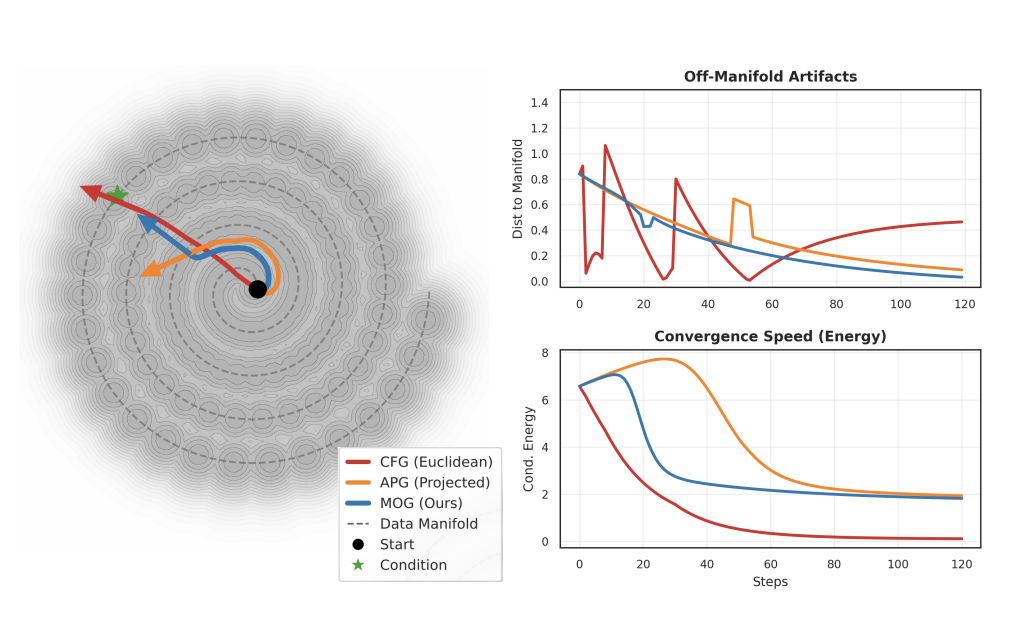
Manifold-Optimal Guidance: A Unified Riemannian Control View of Diffusion Guidance
Zexi Jia, Pengcheng Luo, Zhengyao Fang, Jinchao Zhang*, Jie Zhou
International Conference on Machine Learning (ICML) 2026 Under review
We reinterpret classifier-free guidance as a geometric mismatch: Euclidean CFG pushes samples off the data manifold. MOG formulates guidance as a local optimal control problem and applies a closed-form Riemannian correction (with an Auto-MOG schedule) to reduce artifacts at high guidance without retraining.
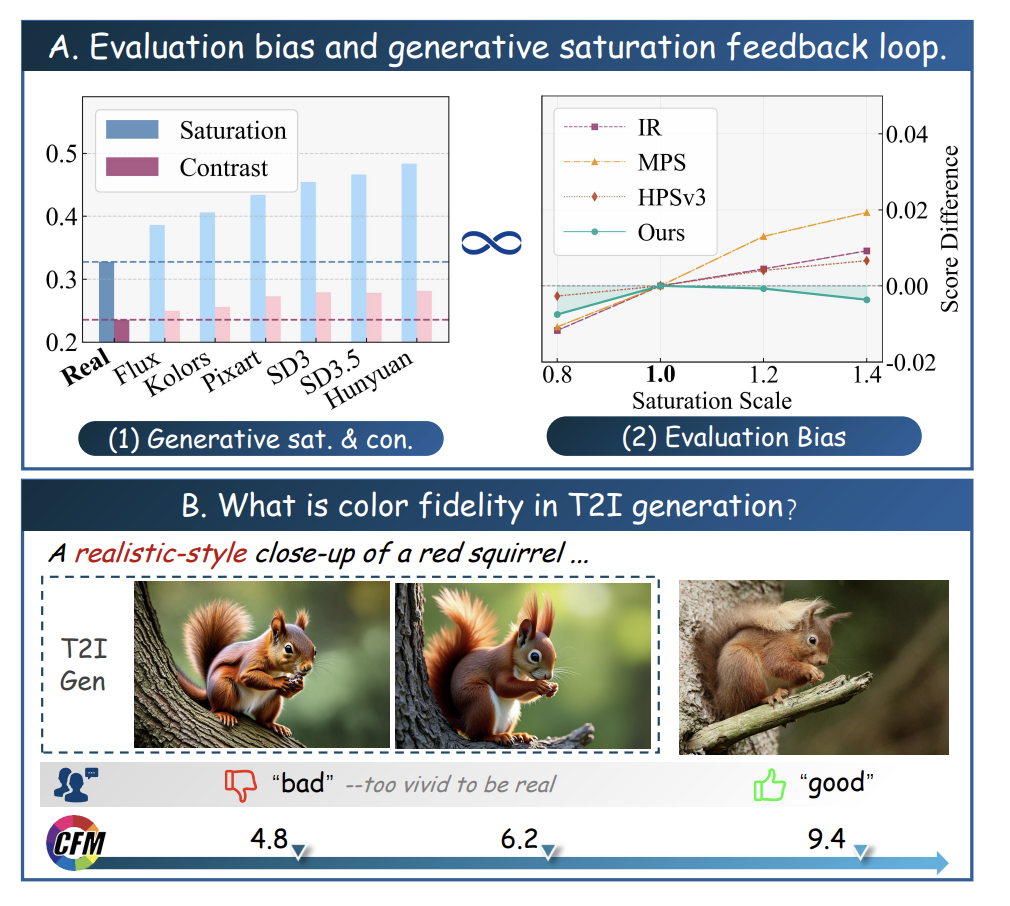
Too Vivid to Be Real? Benchmarking and Calibrating Generative Color Fidelity
Zhengyao Fang, Zexi Jia*, Yijia Zhong, Pengcheng Luo, Jinchao Zhang, Guangming Lu, Jun Yu, Wenjie Pei
IEEE/CVF Conference on Computer Vision and Pattern Recognition (CVPR) 2026 Highlight
Text-to-image models often produce oversaturated “too vivid” outputs when asked for realistic photos. We introduce a color fidelity dataset (CFD), a learned color fidelity metric (CFM), and a training-free refinement (CFR) that calibrates guidance to improve photographic color authenticity.
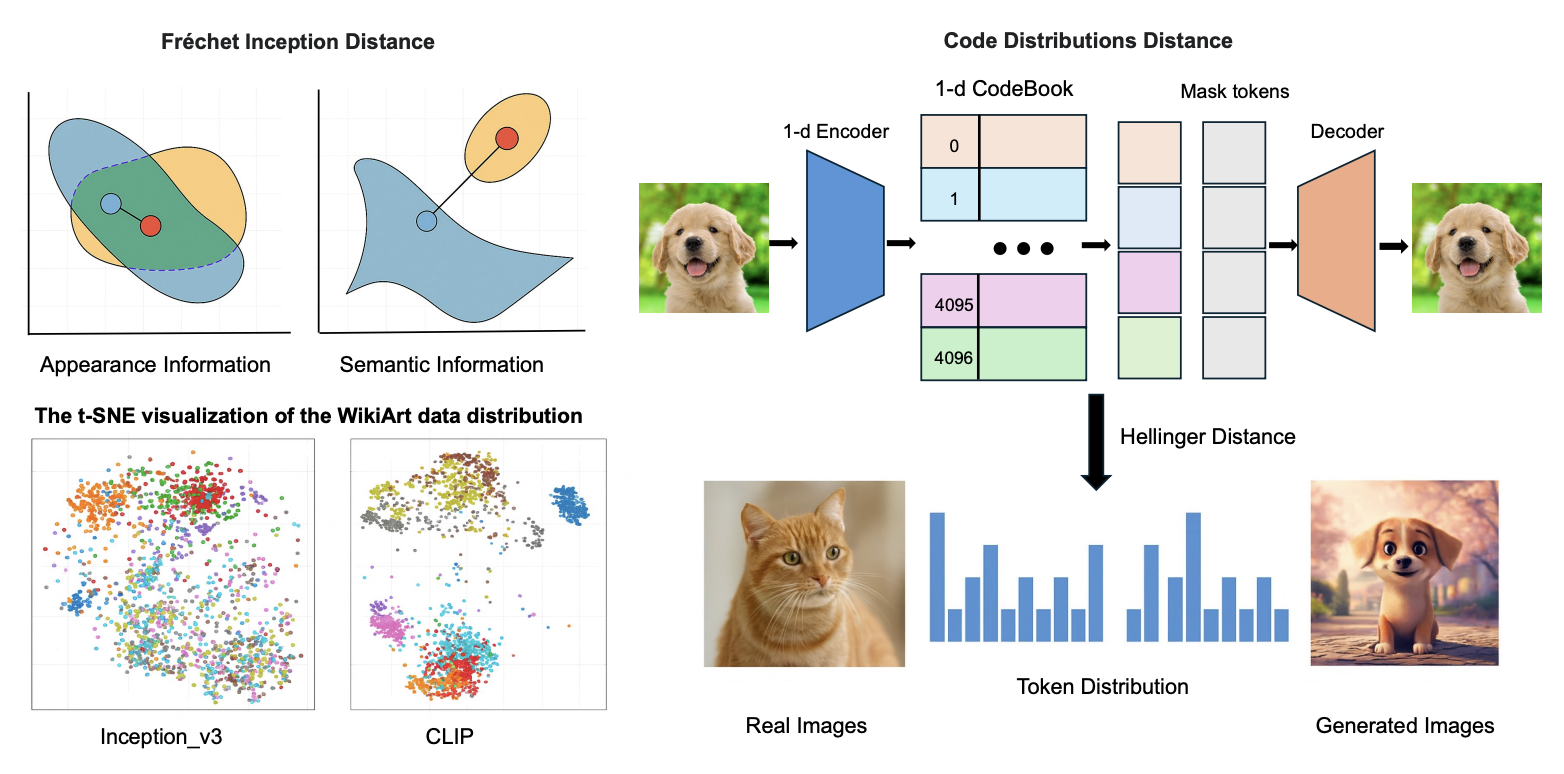
Evaluating Generative Models via One-Dimensional Code Distributions
Zexi Jia, Pengcheng Luo, Yijia Zhong, Jinchao Zhang, Jie Zhou
IEEE/CVF Conference on Computer Vision and Pattern Recognition (CVPR) 2026 Highlight
We propose evaluation metrics based on one-dimensional distributions of discrete visual codes, including CHD and CMMS, which achieve strong correlation with human perceptual preferences when comparing and ranking generative models.
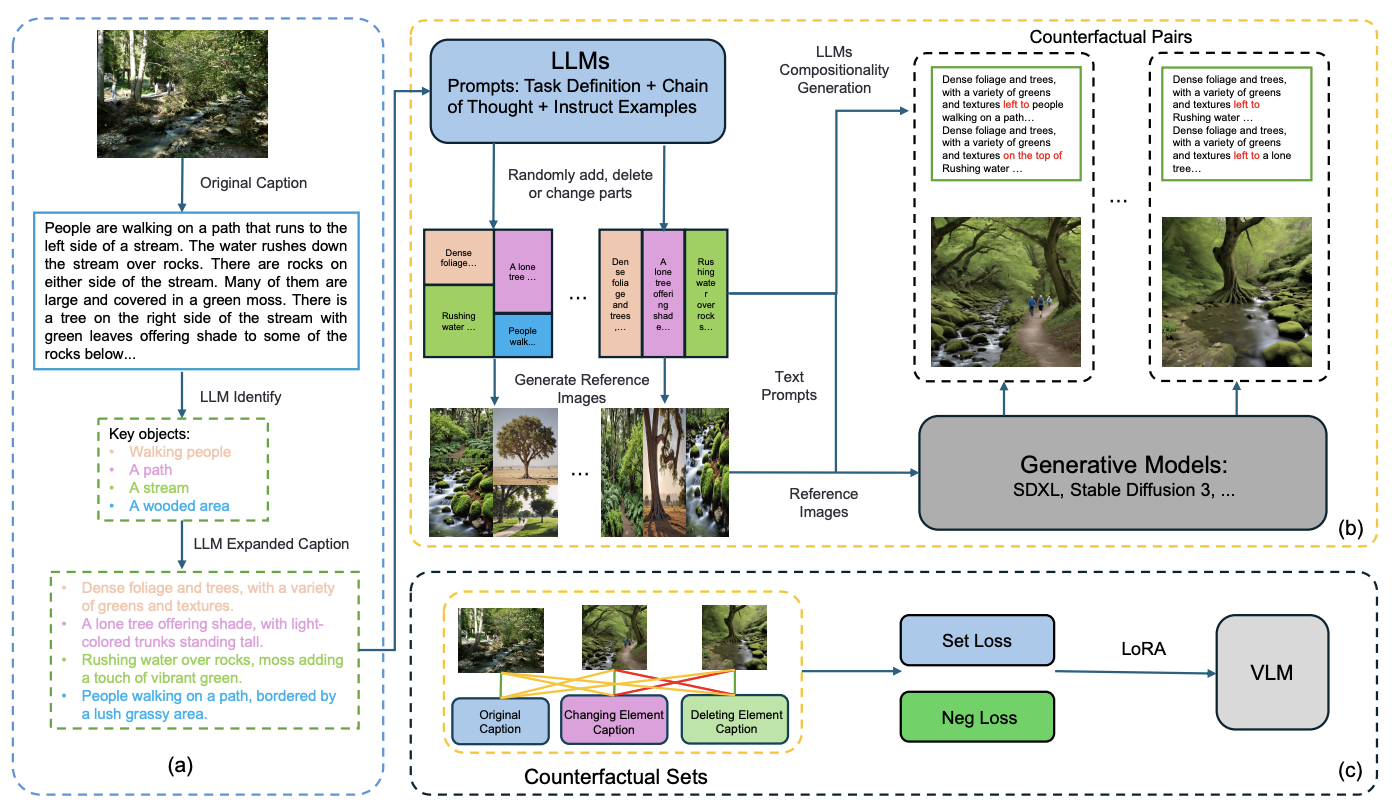
A Visual Leap in CLIP Compositionality Reasoning through Generation of Counterfactual Sets
Zexi Jia, Chuanwei Huang, Hongyan Fei, Yeshuang Zhu, Zhiqiang Yuan, Ying Deng, Jiapei Zhang, Jinchao Zhang*, Jie Zhou
IEEE/CVF International Conference on Computer Vision (ICCV) 2025 Poster
We propose a block-based diffusion framework that automatically generates high-quality counterfactual image–text sets to improve CLIP-style compositional reasoning. Large language models are used to parse entities and spatial relationships, and then guide a “puzzle piece” generation process to compose diverse counterfactual images with precisely controlled variations. Together with a new set-wise loss that separates intra-set and inter-set pairs, our method significantly boosts visual reasoning performance and achieves state-of-the-art results on multiple benchmarks while using substantially less training data.
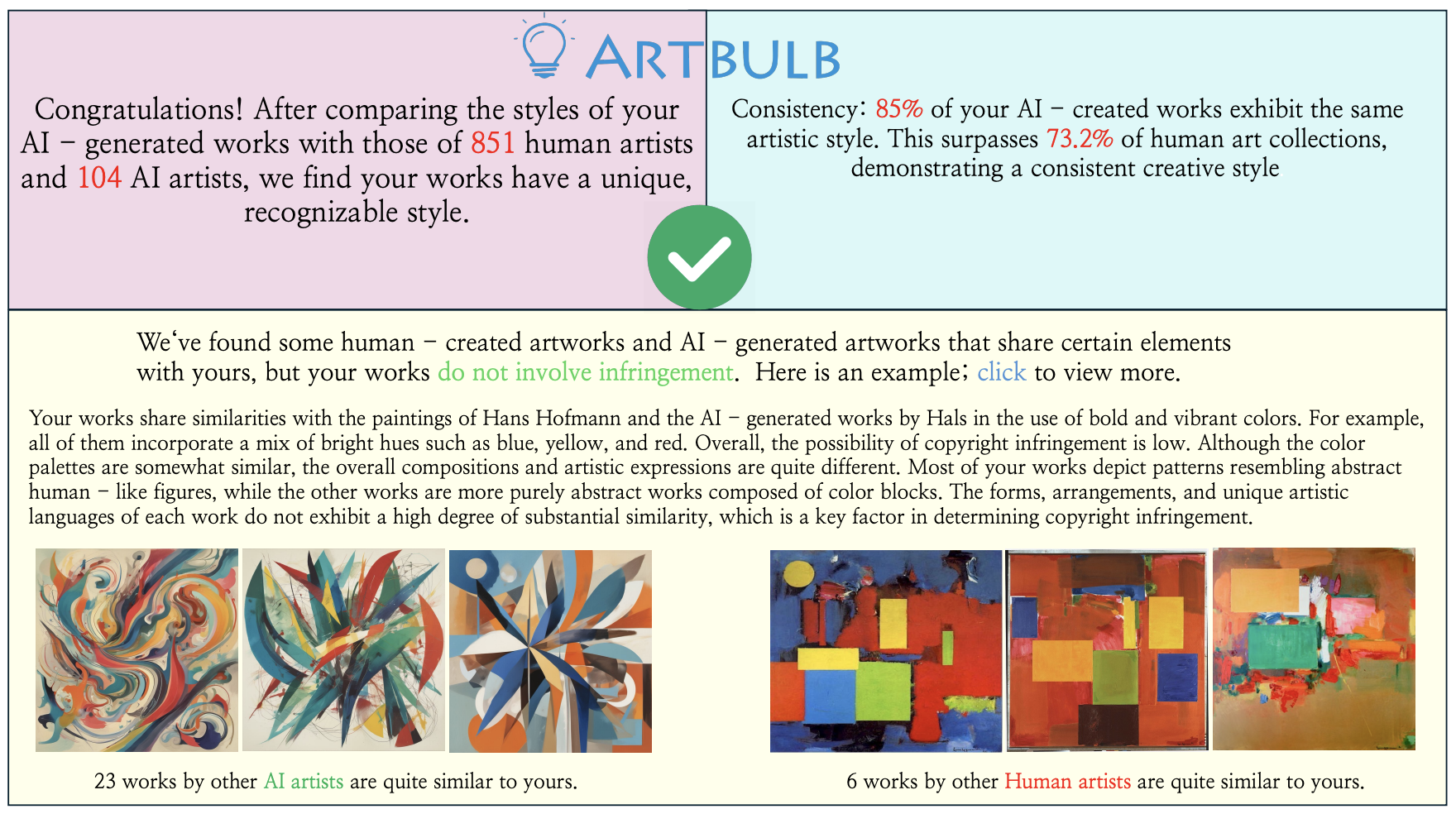
From Imitation to Innovation: The Emergence of AI's Unique Artistic Styles and the Challenge of Copyright Protection
Zexi Jia, Chuanwei Huang, Yeshuang Zhu, Hongyan Fei, Ying Deng, Zhiqiang Yuan, Jiapei Zhang, Jinchao Zhang*, Jie Zhou
IEEE/CVF International Conference on Computer Vision (ICCV) 2025 Poster
We study when AI-generated artworks can be recognized as having their own protectable artistic styles and how to judge potential copyright infringement. Building on legal precedents, we formulate three key criteria—stylistic consistency, creative uniqueness, and expressive accuracy—and propose ArtBulb, an interpretable framework that combines a style description-based multimodal clustering method with multimodal large language models. We also construct AICD, the first benchmark dataset for AI art copyright judgment, and show that ArtBulb outperforms existing methods in both quantitative and qualitative evaluations.
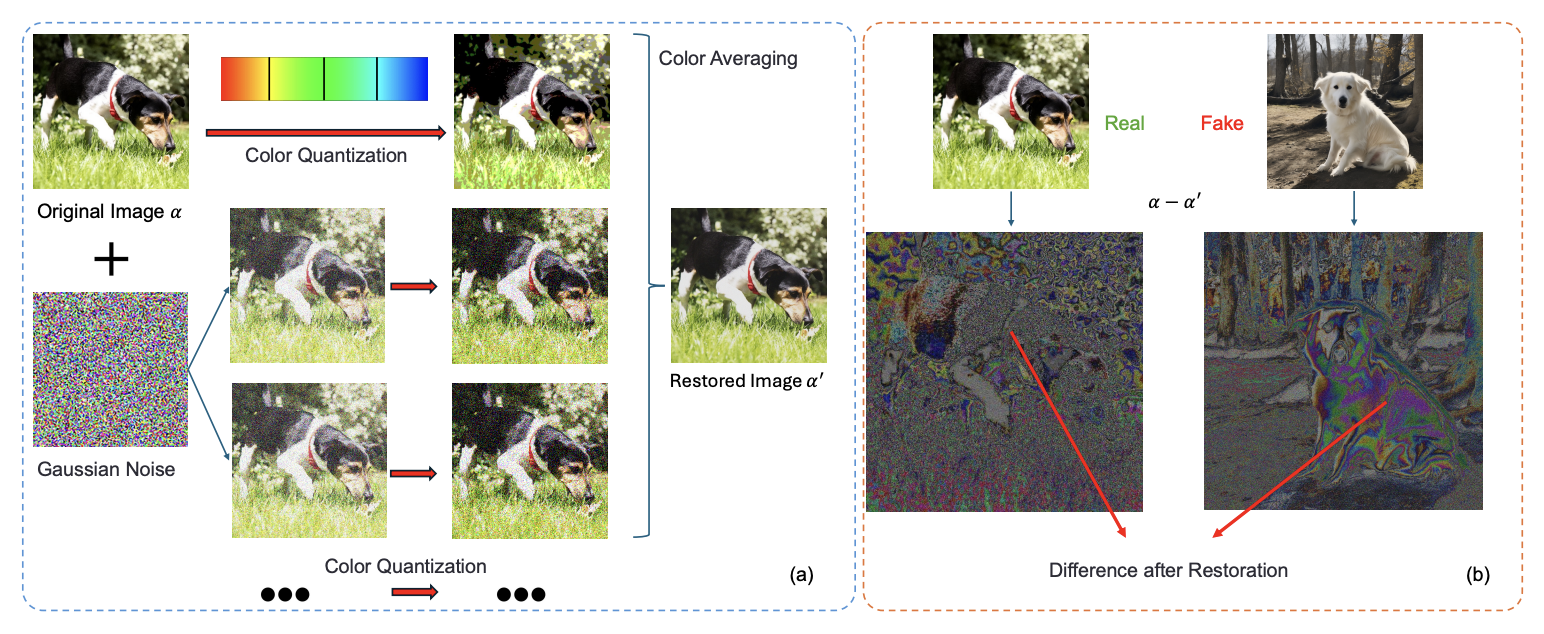
Secret Lies in Color: Enhancing AI-Generated Images Detection with Color Distribution Analysis
Zexi Jia, Chuanwei Huang, Yeshuang Zhu, Hongyan Fei, Xiaoyue Duan, Zhiqiang Yuan, Ying Deng, Jiapei Zhang, Jinchao Zhang*, Jie Zhou
IEEE/CVF Conference on Computer Vision and Pattern Recognition (CVPR) 2025 Poster
We propose a color-distribution-based framework for detecting AI-generated images. By analyzing the differences before and after color quantization and restoration, we extract lightweight color features and combine them with image features to build a 1.4M-parameter detector that achieves state-of-the-art performance on multiple benchmarks, including our new and challenging FakeART dataset.
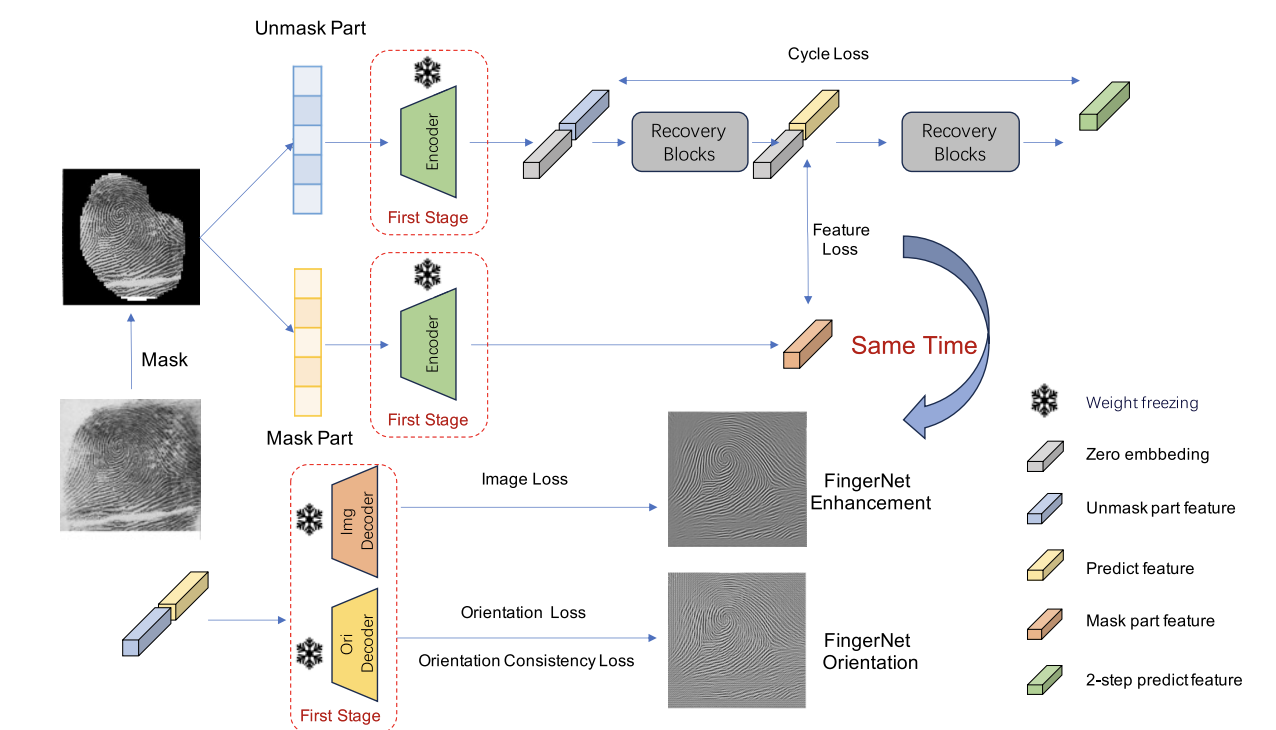
Finger Recovery Transformer: Toward Better Incomplete Fingerprint Identification
Zexi Jia, Chuanwei Huang, Zheng Wang, Hongyan Fei, Song Wu, Jufu Feng*
IEEE Transactions on Information Forensics and Security (TIFS) 2024 Journal
We propose Finger Recovery Transformer (FingerRT), a transformer-based framework specifically designed for incomplete fingerprint identification. FingerRT combines fingerprint enhancement networks with a two-stage architecture—denoising/enhancement and recovery—and incorporates key domain features such as orientation fields and minutiae as supervision signals. By imposing multi-level constraints on features, images, and generation stages, FingerRT effectively removes ambient noise, restores missing ridge structures, and significantly improves recognition accuracy on rolled, snapped, and latent fingerprint datasets.
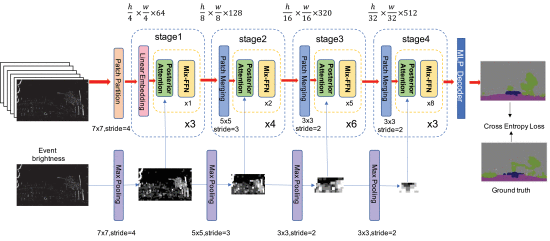
Event-Based Semantic Segmentation With Posterior Attention
Zexi Jia, Kaichao You, Weihua He, Yang Tian, Yongxiang Feng, Yaoyuan Wang, Xu Jia, Yihang Lou, Jingyi Zhang, Guoqi Li*, Ziyang Zhang
IEEE Transactions on Image Processing (TIP) 2023 Journal
We address semantic segmentation using only event-based cameras, which operate in microseconds and remain robust under challenging lighting. To better exploit event information, we propose a posterior attention module that adjusts standard attention with priors derived from events and can be plugged into existing segmentation backbones. Integrated with SegFormer, the resulting EvSegFormer achieves state-of-the-art performance on MVSEC and DDD-17 for event-based semantic segmentation, demonstrating both accuracy and efficiency.